Friday, November 10, 2017

Halloween Harvest ~ October 31

We started off the morning at the Terraces under a fairly overcast sky. 


We harvested and processed some of the sorghum sweetgrass stalks to hand out as Halloween candy at the market. The sorghum is full of sugary syrup which makes it a tasty treat.


After the sorghum cutting we went to the orchard to continue the harvest. The sun broke out of the clouds and it warmed up a little (to ~10 degrees C). 
We harvested beets, carrots, brussels, leeks and potatoes. 


We cleaned them up for market and then proceeded to clear away the brassica and corn to make room for a garlic planting. It was a short but sweet Halloween morning.


Heres a fun video of some people making sorghum syrup!

Tuesday, October 17, 2017

A Visit to Market Day

Twas the morning before market, when all through the terrace
Not a student was stirring, not even the carrots
The 'barrows were parked in the lockup with care,
In hopes that Ag. Students soon would be there;

The veggies were nestled all snug in their beds
While visions of market-day danced through their heads;
And 'Becca in her boots and Mike in his cap,
Had just walked us students for a wet terrace lap,

When out on the lawn arose such a clatter,
We sprang from the beds to escape the rain which was fatter.
Away to the overhang we ran with a splash
'til open the clouds and the sun did flash.

The sun on the veg in the new fallen rain,
gave the lustre of mid-day to students still sane.
When what to our wondering eyes did appear
but a miniature farm truck, a Nissan Frontier.

With a fit young driver, so lively for the mornin'
We knew in a moment it must be manager Torin
More rapid than eagles his students they came,
And he whistled and shouted and called them by name!

Now Biebl now Piper now Will Bailey-Elkin
On Lindsay on Jordan on Emily McEachern
To the top of the kale! to top of the wash stall!
Now wash away! wash away! wash away all!

As dirty leaves before the wash hurricane clean
When we meet with an obstacle, bound to the scene.
So down to the lockup the students they flew
packed the truck full of veg and farmer Torin too.


Wednesday, October 4, 2017

You Can't Beet These Honest Prices

October is officially here and the days are starting to get nice and crisp. On October 4th, 2017 our class had lovely fall weather--the type of weather where you dress in your warmest clothes but need to remove half your layers by 10 AM. Richmond had a high of 15°C with sun throughout the entire day.
Mike, ensuring that our processing station is up to snuff.

While the morning’s weather was calm and sunny, there was a definite sense of urgency in Mike and Rebecca’s voices. Our usual walk-around to assess the Terrace Garden had to be skipped so we could get right into harvesting for the afternoon market. Now that our Agroecosystems class is only three hours long, and once per week, our class is still figuring out how to use so little time in a productive manner that still contributes to our learning objectives and the overall productivity of the KPU farm. Our group harvested a small amount in a short period of time so some of the class could head over to the Orchard to pick various squash for the market. The crops harvested on the Terrace Gardens were lettuce, arugula, kale, tomato, pepper, zucchini, and cucumber. While our latest seeding of greens was growing beautifully, I believe we harvested the last of our tomatoes, peppers, and cucumbers of the season.
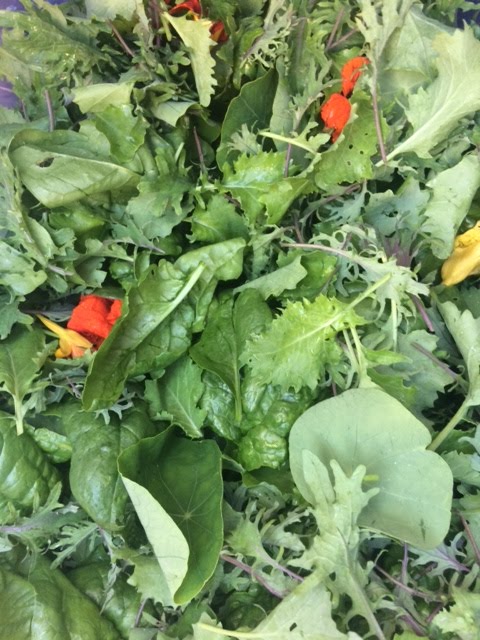
Freshly cut and washed mixed greens.


Once the Terrace harvest was complete we met Torin and Grace downstairs in the sustainable agriculture storage area. Torin and Grace had just finished harvesting an abundance of produce from the Orchard Farm-- so, we amalgamated all of our bounty, and loaded the truck up for the market. Since Nick and I were volunteering to help run the market stand, we hopped into the truck with Torin, Grace, and Johnny, while the rest of the class went to go harvest squash at the Orchard.
Jordan, finalizing some very important documents.

As we drove to the market location we discussed a recent CBC Marketplace episode, which uncovered and made public the issue of Ontario farmers market vendors selling produce that was not grown on their farms. Many of the farms that were investigated told bogus stories of how they grew and harvested their produce from their own land, when in reality they had stopped by the local wholesale distributor, removed the stickers, and re-sold it as their own. While lying to your customers is always an unethical thing to do, our discussion led me to believe that re-sellers do have a place in farmers markets, and that publicly shaming produce sellers, and farmers may not be the right route to go if creating a sustainable food system is the objective. Torin’s family runs a vegetable farm in the region of Ontario where the investigation took place, and immediately after the investigation his family estimated that 1 out of 5 customers interrogated them about whether or not their produce was truly grown on their farm. This attitude will surely create more distrust between both the producer and consumer.
Setting up the KPU market stand.

This topic brings up a consistent issue in our food system: the local food movement has trained consumers to believe that ‘knowing thy farmer’ is the only thing that is needed to ensure a sustainable food system. While this is key, I believe consumers should also attempt to educate themselves around the food system as a whole and the interdependence of the many different scales of agricultural production that currently exists. Re-selling produce is quite critical to many vegetable farmers, as it allows them to have a larger number of products to sell, and while a farmer may be incredibly passionate about growing the finest cabbage, his or her ability to re-sell some peppers alongside that cabbage, could just keep their business stable and secure.
 

Ontario boasts some of the largest, most vibrant farmers markets in Canada, and this is most definitely due in some part to farmers who re-sell produce. Furthermore, re-sold wholesale produce is usually going to be cheaper, making farmers markets accessible to both low and high income citizens. Everyone deserves the right to walk outside and buy their groceries under the summer sun.

So, while I do not support any entrepreneur who knowingly lies about the origins of their product, I still do not support the public shaming that took place in the CBC Marketplace episode. If we want to practically deal with farmers market vendors who lie, here are some policies that could be put in place: 

  • Have a cap on the number of re-sellers/ wholesale distributors that are allowed in a farmers market. 
  • Institute a policy that requires all re-sellers advertise where their products are truly from. 
  • Have third-party audits of all farmers market vendors.  
KPU market stand

The rest of the day went very well. We had a small rush of people during the first hour, and steady customers until the end of the market. Although we didn't completely sell out, our sales were estimated at just above average. On a high note, everyone loves our beets! So many repeat buyers commented on the delicious flavour, and the beautiful variety of colours that were offered.


Wednesday, September 27, 2017

Getting Ready for the Market-ocalypse!

Tuesday September 26 2017

Even though we are in autumn now, the sun and the heat came by to say hello one last time this Tuesday!
Early Blight on Cherry tomatoes


During our usual walk about we assessed the terraces to see what is to be harvested for the market, and what is to be taken out because of the change of seasons, or disease.
Cucumber season is now over,  but there was enough greens for a few bags of salad blend.

The Cherry tomatoes are still producing despite the presence of early blight, and the nasturtiums bounced back very nicely after being infested with aphids in the summer. 


The Kale Trial: no data was taken from the kale trial this week.
Rep 1 is improving! This could be do to the cooler temperatures which kale can thrive in.
Rep 2 by the sunflowers is still pathetic, which isn’t surprising as they are so close to the sunflowers that can exude phytochemicals that can restrict the growth of other plants nearby.
Rep 3 looks like it has been hit with some powdery mildew near the base of some of the plants, and some plants were even starting to bolt, which is concerning at this time of the year.


Piper giving the melon a sniff

Stark preparing a breakfast snack for us all


Scalopini
Mike checking out the mystery squash

Arugula
Baby Kale
Nastursiums


The arugula on the terraces is doing very well! And the kale next to the arugula was harvested as baby kale to add to the salad blend, as well as mustard greens.


Piper and Will transplanting onions

Once the truck was packed up and off to the market the rest of the students transplanted some very sad looking onions, and we will all have to cross our fingers that they will survive the transplant!


Some weeding was done, as that is always needed, and then that was it!


The Market:

It was a race to the finish line on the terraces as always! The truck needs to get to the market site and have everything set up by noon, and as always (at this new location) it was a very busy start. Stark even said he had to fend off customers before the market opened like they were zombies in the Walking Dead!


Last weeks market broke the all time record in sales, unfortunately this week was not as successful as last week, but there are no complaints from anybody because this new location is so much more profitable then the previous location on campus.

Tuesday, September 26, 2017

The taste and smell of Fall.

Perhaps you have noticed that little chill in the air that arrives at night, or sometimes even earlier in the day? Or maybe you have remarked that the evening air has a distinct smell, a smell which I find rather difficult to describe, yet somehow I know that fall is in the air and that soon winter is coming...

Basil initiates flowers as days get shorter and a nightly chill sets in
It is now officially fall. However, the changing season has been evident long before arriving at the calendar date, Sep. 22, which marks the vernal equinox. As we arrived for school, the full intensity of summer clung on desperately, with intense heat, and sunlight, only to be modified slightly by lingering smoke . Even though I had left to do research in Mexico for a month and was largely absent during the month of August, being back in the Lower Mainland, I was reminded of the oppressiveness of the smoke and heat that engulfed everything. The grass was so parched by this time, that it would shatter to a fine powder as it was tread on. Finally, a break...........

relief...... by the end of week, it rained.

At this time, the weather became more livable with reasonable temperatures. This shift was not the only change that was set in motion by the arrival of the first rains. The nighttime temperatures had started to drop to the low 10's creating a noticeable difference between the day and night temperatures.

Hazel cleaning the bin between harvests
Similarly, in our weekly harvest these changes have become evident. At the third week of the semester, we were still able to harvest lots of heat loving summer annuals such as: tomatoes, peppers, okra, basil, cucumbers, and shiso; but these have noticeably slowed down in their ripening resulting in much lesser yields than the previous weeks harvests. We would have harvested zucchini, but that pretty much entirely succumbed to powdery mildew (picture below). We also harvested some more cold tolerant crops such as leafy greens - kale, lettuce, spinach, arugula; nasturtium leaves and flowers, hakurei turnips. Even the more cold hardy crops offered only modest harvests - it is a time of transition after all, and lots of our fall harvest crops have yet to reach sufficient maturity for harvest.
A meager tomato harvest

Nic harvesting basil
The peppers are still hanging in...
Shiso
Piper preparing the produce to be weighed
The produce above is what we were able to harvest off the terrace. Additionally, we had potatoes and beans in cold storage from the previous week's harvest, and had a few students working with Torin to  harvest celery, leeks, beets and corn that day. All of the produce was weighed, and then processed into bags and was then aggregated at around 11am, to be transported by truck to the Farmers Market at Minoru Plaza.
The last of the hakurei turnips

Nasturtiums in their element
Arugula
Oak leaf lettuce
As is usual, doing the market harvest leaves us with little time, but we do our best to attend to the needs of the terrace as much as time permits. For example, Jordan busied himself with the harvest of rye seed, and carrot seed, and then cleaning up the spent cucurbit plants (mostly zucchini). Some students and Mike set about tackling weeds with hoes in hand.


Jordan posing for the camera
These plants gave up on life because of powdery mildew
At the very end of class, all of the students congregated to hear Mike's report about the latest news with Garden City lands. It seems we have encountered another snag in gaining the right to farm the GC lands. The ALC has sent an order to Richmond municipal council to remove a foot of soil. For various reasons, the council does not agree with the order, and nor do our instructors. Mike explained that given the mandate of protecting soil for current and future farm use, adding 2 feet of non-native soil is counter to the purpose of the ALR. However, adding the extra soil is critical for two important reasons: the soils of GC lands are highly contaminated with led from past uses (rifle range, control tower), and by adding extra layers the risk of the led being bio-accumulated by produce is greatly reduced. The second reason, involves the greater context of climate change induced by anthropogenic activity - e.g. the accelerated release of GHG into the atmosphere. In this context, all the peat in GC lands is huge reservoir of organic carbon, which if cultivated in a conventional matter (ie: being drained and tilled) will quickly transform into a huge source of CO2 gas in short manner of time. In contrast, and even though minerals soils are not as productive as organic soils, they can actually increase in soil organic matter overtime with sound practices, thereby becoming a sink for atmospheric carbon. To summarize, adding a good layer of mineral soil overtop of the peat may actually help preserve thereby stopping it's degradation and release of CO2 gas. Given that maintaining the mineral soil cover is imperative, and the city is trying to resist this order.
Mike and his children (sorghum)

With that, the class was over - actually, it had already ended 10 minutes before, but I think we were all intrigued to get caught up with the latest on the Garden City saga.


Assessing the state of the cherry tomatoes